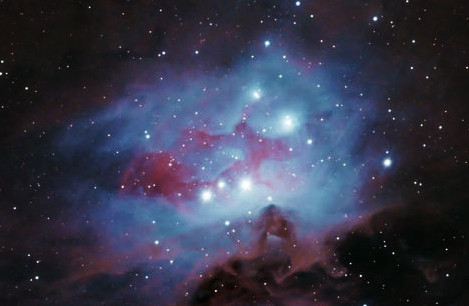
NGC 6726, NGC 6723
Constellation: Corona Australis

This image depicts a region in the constellations of Corona Australis, that are rich in celestial objects. In contains the globular cluster NGC 6723 (a.k.a the Chandelier cluster) as well as the reflection nebulas NGC 6726, NGC 6727, NGC 6729 and IC 4812. NGC 6723 is located about 28’400 Ly from Earth. Link to interactive sky chart.
The region contains a molecular cloud with many Herbig-Haro objects and young stars. It is one of the closest star-forming regions to Earth (430 Ly).
Dates:
Data acquired remotely between August and September 2023 using Martin’s equipment.
His telescope is located in Australia (Observatory: Heaven’s second mirror, NSW).
Colour palette is HaLRGB.
Telescope & Mount:
SharpStar 140mm (F4.8) on a Software Bisque Paramount ME II mount.
Imaging:
Camera: SBIG STXL16200, FW8G
Data:
Antlia Ha: 33x600s
Antlia L: 41x300s
Antlia R: 56x300s
Antlia G: 50x300s
Antlia B: 58x300s
Total integration time: 22h 35′
A broader field of view is depicted below:
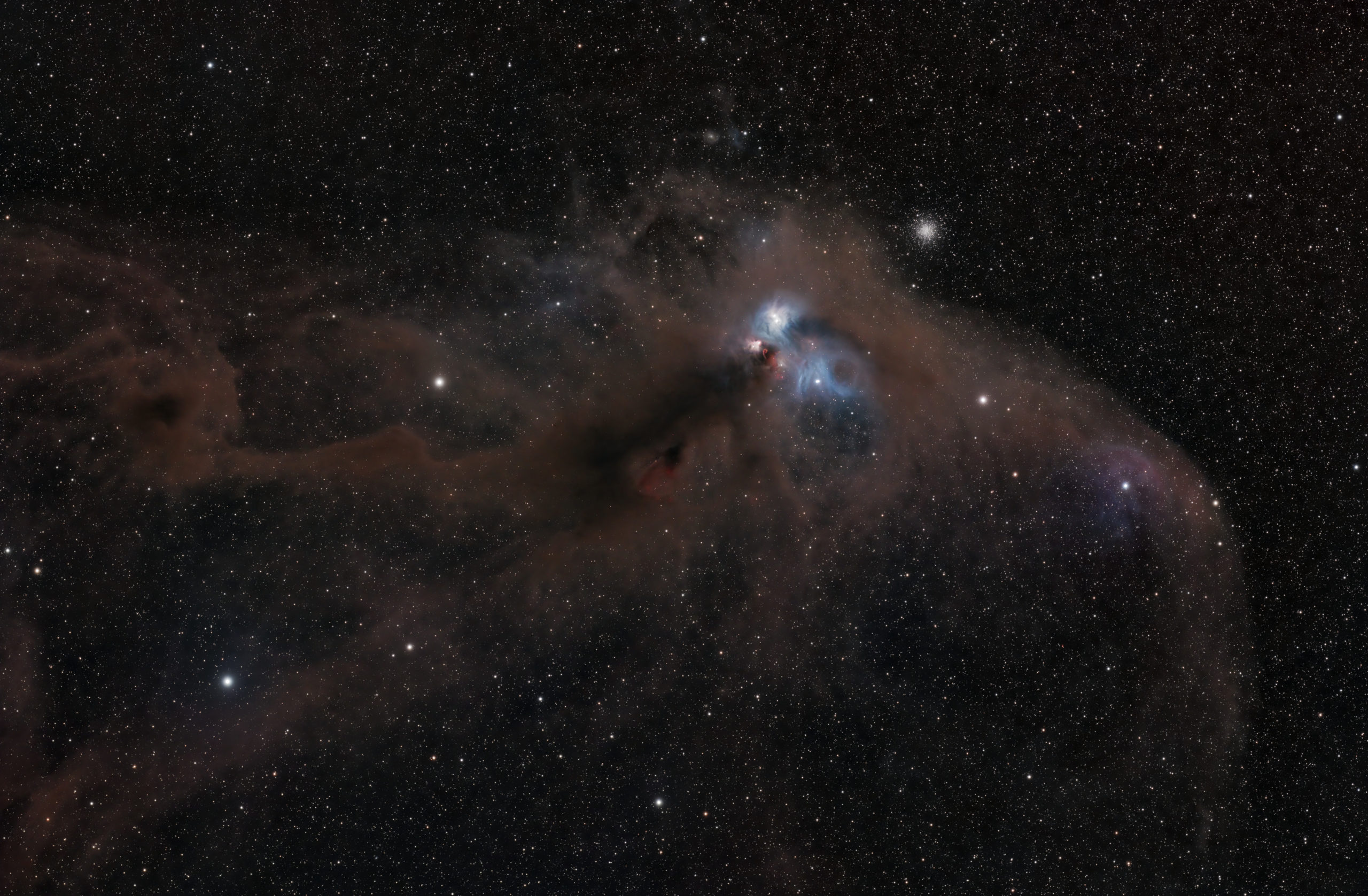
This broader field also captured MCG-06-42-001, and active galaxy nucleus candidate North of the main objects and two additional reflection nebulae: a) a faint one just West of MCG-06-42-001 likely due to the young stellar object HD 176497 (spectral type A0IV) and b) one to the West around the 5th magnitude α2 CVn variable star V* V686 CrA (spectral type B3V).
Dates:
Data acquired remotely between June and July 2026 using my equipment located in Australia (Observatory: Heaven’s second mirror, NSW).
Colour palette is LHaRGB.
Telescope & Mount:
Askar SQA70 (F4.8) on a ZWO AM5N mount.
Imaging:
Camera: Player One Poseidon-M Pro
Data:
Astronomik Ha: 119x300s
Astronomik Lum: 129x120s
Astronomik Red: 118x120s
Astronomik Green: 140x120s
Astronomik Blue: 151x120s
Total integration time: 27h 51′
Some further details about this region:

Herbig-Haro objects near NGC 6726.

Other Herbig-Haro objects in the molecular cloud region.

A closer view of the core region and its Herbig-Haro objects:
Telescope & mount: Planewave CDK24 (F6.5) on a Planewave L600 mount.
Camera: Moravian G3-61000 (bin 2×2)
Data:
Astrodon R: 10x600s
Astrodon G: 9x600s
Astrodon B: 11x600s
Astrodon Ha: 15x900s
Total integration time: 8h 45′
Data captured by Martin Pugh in Chile. Remote Astrophotography with Martin Pugh (martinpughastrophotography.space)

With this powerful telescope everal additional Herbig-Haro objects can be seen near NGC 6726 . The stars circled in red are Herbig Ae/Be Stars, which are pre-main sequence stars of spectral lass A or B. They are less than 10 million years old and are still embedded in the gas and dust cloud from whoich they are formed.